
Why AI literacy Is becoming as important as math and science in schools?

TL;DR:AI literacy is emerging as a foundational skill alongside math and science because it helps students understand, evaluate, and use AI responsibly. As AI becomes part of education and everyday life, learners need critical thinking, problem-solving, and ethical decision-making skills. Structured learning opportunities can help students move from AI awareness to real-world application and future readiness.
Artificial Intelligence is no longer limited to technology companies or research labs. It is already shaping how students search for information, receive recommendations, interact with digital tools, and learn new concepts every day.
UNESCO notes that AI has the potential to transform education while also requiring learners to understand its opportunities, limitations, and risks. As AI becomes increasingly woven into everyday life, education systems around the world are beginning to rethink what students need to know to thrive in the future.
In much the same way that schools teach mathematics to develop logical thinking and science to encourage inquiry, AI literacy is emerging as a critical skill for helping students navigate an AI-powered world responsibly. The goal is not to turn every student into an AI engineer. Instead, it is about helping learners understand how AI works, how it influences decisions, and how they can use it thoughtfully, ethically, and effectively.
Why AI literacy is the next evolution of essential learning in schools?
Education has always evolved to prepare students for the world they are entering.
Reading and writing helped people access knowledge. Mathematics developed logical thinking and problem-solving abilities. Computer literacy became essential as the digital age transformed industries and everyday life.
Today, AI is already a part of the journey.
Students are already interacting with AI through learning apps, recommendation engines, voice assistants, search tools, and content-generation platforms. Yet many are learning with AI before fully understanding it.
This shift is prompting educators and parents to ask an important question: if AI is becoming a part of everyday life, shouldn't students understand how it works and how to use it responsibly?
Increasingly, the answer is yes. AI literacy is not replacing traditional subjects. It is becoming a complementary skill that helps students apply what they learn in a world where intelligent technologies are becoming commonplace.
Also Read: AI Literacy for Non-Technical Roles
How can students can learn to thrive?
The value of AI literacy goes far beyond understanding technology.
At its core, AI literacy is about helping students become informed, adaptable, and confident learners.
In a world where information can be generated in seconds, students need the skills to evaluate what they see, ask meaningful questions, and make thoughtful decisions. Understanding AI helps learners move from simply consuming information to actively analyzing and applying it.
Through AI literacy, students can develop:
- Critical-thinking skills
- Problem-solving abilities
- Digital awareness
- Information-evaluation skills
- Ethical decision-making capabilities
Most importantly, these skills remain relevant even as technology evolves. AI tools may change over time, but the ability to understand and work with emerging technologies will continue to be valuable throughout a student's education and career.
What are the skills that the future careers will demand?
The impact of AI is no longer limited to the technology sector.
Healthcare professionals are using AI-assisted tools. Businesses rely on AI-driven insights. Designers explore AI-powered creativity. Entrepreneurs use AI to accelerate innovation. Across industries, people are learning how to work alongside intelligent systems.
As a result, future career readiness will increasingly depend on a combination of technical awareness and uniquely human capabilities.
The skills that employers are expected to value most include:
- Creativity
- Communication
- Critical thinking
- Leadership
- Adaptability
- Ethical judgment
These are skills that become even more important in an AI-enabled world.
When students understand both AI and these human-centric capabilities, they are better positioned to innovate, collaborate, and contribute meaningfully across a wide range of professions.
How can they start early?
Like reading, mathematics, and science, AI literacy develops over time. Young learners can begin by exploring where AI appears in their daily lives and understanding how it influences the digital experiences they interact with every day.
So, Understanding what AI is? represents an important first step. The next challenge is helping learners apply that understanding in meaningful ways.
As AI becomes an increasingly important skill, learners need more than awareness. They need opportunities to build practical capability.
This is where structured learning pathways can make a meaningful difference.
From Learning about AI to leading with It
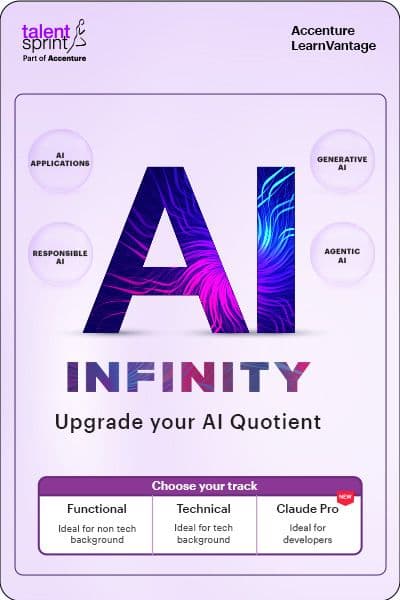
AI Infinity is designed to help learners adopt AI faster by empowering them to learn, apply, and lead with AI.
Rather than focusing only on theory, the program combines expert-led instruction, hands-on experiences, practical assignments, and real-world projects that help learners build confidence and capability.
Participants can:
- Learn live from AI experts through 40 hours of interactive sessions designed to make complex concepts simple and actionable.
- Experience 20+ leading AI tools, including ChatGPT, Copilot, Gemini, Perplexity, and others, to understand how AI can support learning, productivity, creativity, and innovation.
- Turn learning into outcomes through 12 industry-relevant AI projects that help bridge the gap between knowledge and application.
- Track progress continuously with 20 skill-based assignments that help learners measure growth and build confidence.
- Learn anytime, anywhere through self-paced resources that support flexible learning schedules.
- Continue growing beyond the program with six months of access to learning materials and updated content.
Most importantly, the focus extends beyond using AI tools. It is about understanding where AI creates value, how it can solve real problems, and how it can be applied responsibly.
Built for every learning journey
One reason AI literacy is becoming so important is that AI is no longer relevant only to technical professionals.
AI Infinity reflects this reality by supporting a wide range of learners:
- Students and freshers
- Working professionals
- Career switchers or returning professionals
- Entrepreneurs and freelancers
Learning tracks for different goals
Recognizing that every learner starts from a different point, AI Infinity offers distinct pathways:
- Functional Track
Ideal for non-technical learners who want to use AI tools to simplify, accelerate, and improve everyday work. - Technical Track
Designed for technical learners interested in designing, deploying, and managing AI-powered systems. - Claude Pro Track
Created for developers who want to leverage AI for engineering workflows, automation, governance, and enterprise-scale development practices.
By offering multiple pathways, the program helps learners build AI literacy in ways that align with their goals and aspirations.
Hence, Preparing students for the next literacy revolution
History shows that education evolves alongside the world around it.
Just as reading, mathematics, science, and computer literacy became essential for previous generations, AI literacy is emerging as an important competency for the next one. It is not competing with traditional subjects. Instead, it strengthens students' ability to apply what they learn in an increasingly AI-powered world.
The students who thrive in the future will not simply be those who have access to AI. They will be the ones who understand it, question it thoughtfully, use it responsibly, and combine it with uniquely human strengths such as creativity, empathy, collaboration, and innovation.
That is why AI literacy is no longer just a technology skill. It is becoming a life skill for the next generation.
Also Read: Is Agentic AI the final leap in the AI revolution?
Frequently Asked Questions
Q1. Is AI literacy really as important as math and science?
AI literacy complements math and science by helping students understand and use intelligent technologies responsibly. It develops critical thinking, digital awareness, and problem-solving skills that are increasingly valuable in education, careers, and everyday decision-making.
Q2. At what age should children start learning about AI?
Children can begin learning AI concepts through age-appropriate activities that explain how AI appears in daily life. As they grow older, they can explore topics such as ethics, responsible use, data privacy, problem-solving, and real-world AI applications.
Q3. How does AI literacy help students prepare for future careers?
AI literacy helps students develop transferable skills such as critical thinking, creativity, communication, adaptability, and ethical judgment. These capabilities are valuable across industries and enable learners to work effectively alongside AI-powered technologies in the future.
About the Author
TalentSprint
TalentSprint, Part of Accenture LearnVantage, is a global leader in building deep expertise across emerging technologies, leadership, and management areas. With over 15 years of education excellence, TalentSprint designs and delivers high-impact, outcome-driven learning solutions for individuals, institutions, and enterprises. TalentSprint partners with leading enterprises and top-tier academic institutions to co-create industry-relevant learning experiences that drive measurable learning outcomes at scale.
Explore Our Programme
Advance your career with the right program

Related articles
AI and Machine Learning
The Real limitations of AI in real-world Workflows
“AI can do it.”
That’s often where the conversation starts.
But once AI becomes part of everyday work, organizations begin asking a different question:

AI and Machine Learning
How AI competitions help you stand out in school, college, and careers?
If you've spent any time online recently, you've probably come across some version of these questions:
"Will AI take my job?"
"Should I still go to college if AI c

AI and Machine Learning
The Gap Between Learning ML and Solving Real Problems
Imagine this.
You've completed a machine learning course. You understand regression, decision trees, clustering, neural networks, and evaluation metrics. You've built a few portfolio projects