
How AI competitions help you stand out in school, college, and careers?

TL;DR:AI competitions help students stand out by demonstrating skills that grades alone cannot showcase. They build problem-solving ability, encourage practical learning, and provide opportunities to apply AI concepts in real-world scenarios. Platforms like the National AI Olympiad (NAIO) help learners benchmark their AI readiness, develop future-ready skills, and strengthen their academic and career profiles.
If you've spent any time online recently, you've probably come across some version of these questions:
"Will AI take my job?"
"Should I still go to college if AI can do so much?"
"What should I study when technology is changing every industry?"
It's easy to feel uncertain when headlines constantly talk about automation, AI-powered tools, and the future of work. But while AI is changing how we learn and work, it isn't replacing the need for human skills such as critical thinking, creativity, communication, and problem-solving.
In fact, the students who are likely to thrive in the AI era may not be the ones who know the most about AI. They are the ones who know how to apply it, work with it, and demonstrate those skills through meaningful experiences.
This is why AI competitions are becoming increasingly relevant. They help learners move beyond theory, build practical skills, and create proof of capabilities that schools, colleges, and employers value.
The real advantage isn't avoiding AI. it's learning how to use It.
Many students worry about choosing the "right" degree or career path in an AI-driven future.
The reality is that AI is influencing almost every field, from business and healthcare to engineering, design, finance, and marketing. Instead of asking which careers are safe from AI, a more useful question might be, “How can I become someone who can work effectively in an AI-enabled world?”
This is where AI literacy becomes important.
Students who understand how AI works, where it can be applied, and how to use it responsibly are likely to be better prepared for future academic and professional opportunities.
Employers are no longer looking only for degrees. They increasingly value candidates who can adapt, learn continuously, and apply emerging technologies alongside domain knowledge.
If everyone has access to AI, what actually makes you different?
Today, almost anyone can access AI tools.
Students can use AI for research, brainstorming, writing assistance, coding support, and learning.
But access alone does not create an advantage.
The real differentiator is what you do with that access.
Consider these two students:
Student A
- Uses AI tools to complete assignments
- Consumes information
- Learns concepts when required
Student B
- Uses AI tools
- Participates in AI competitions
- Solves challenges independently
- Builds projects
- Demonstrates practical application
Both students have access to the same technology.
The difference is that one has evidence of applying what they've learned.
That distinction often becomes valuable when applying for colleges, internships, scholarships, and future jobs.
Why AI competitions matter more than many students realise?
AI competitions do much more than test technical knowledge.
They encourage students to think critically, solve problems creatively, and approach challenges with curiosity.
Participants often gain experience in:
- Logical reasoning
- Analytical thinking
- Problem-solving
- Applied learning
- Collaboration and innovation
- Understanding real-world applications of AI
Most importantly, competitions create opportunities for students to move from learning concepts to demonstrating capabilities.
In an increasingly competitive environment, that can make a significant difference.
Also Read: Why the National AI Olympiad is the new competitive edge for students?
How AI competitions strengthen college applications?
College admissions teams increasingly look beyond grades alone.
Academic performance remains important, but institutions also value students who show initiative, intellectual curiosity, and a willingness to learn beyond the classroom.
Participating in AI competitions can help demonstrate:
- Interest in emerging technologies
- Commitment to continuous learning
- Problem-solving ability
- Engagement beyond the school curriculum
- Readiness to explore interdisciplinary fields
For students interested in technology, business, engineering, economics, healthcare, or research, these experiences can strengthen an overall profile by showcasing meaningful engagement with future-focused skills.
The goal is not simply participation. It is demonstrating a genuine willingness to explore, learn, and apply knowledge.
Can AI skills help you land better internships?
Many students believe internships become important only at the end of college but if we look in reality, building experiences early can make internship applications stronger.
Recruiters often evaluate candidates based on more than academic performance. They look for evidence of initiative, curiosity, and practical exposure.
AI competitions can contribute to this by providing opportunities to:
- Solve real-world challenges
- Work on projects
- Develop analytical thinking
- Build confidence with emerging technologies
- Showcase learning beyond coursework
When students can discuss experiences, projects, or competition-based learning during interviews, they often have stronger examples to demonstrate their skills and interests.
Degrees help open doors.
Experiences often help students stand out once those doors are open.
How AI competitions turn learning into proof?
Many students today are learning about AI through videos, online courses, and AI-powered tools. That's a great starting point. But when it comes to college applications, internships, or future careers, one question often remains, “How do you show what you've learned?”
This is where AI competitions can make a difference.
They give students an opportunity to move beyond simply consuming information and start applying it. Instead of only stating an interest in AI, learners get a chance to solve challenges, assess their skills, and demonstrate initiative in a structured environment.
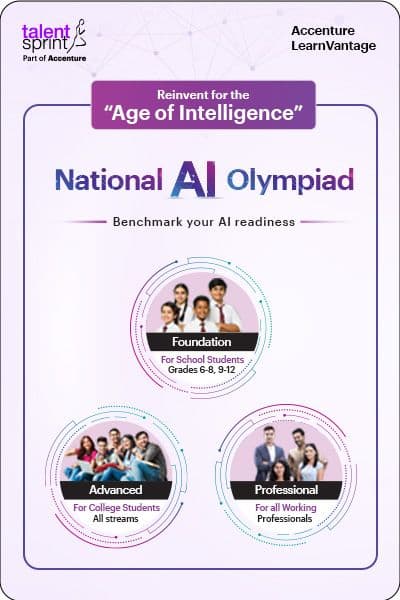
For example, the National AI Olympiad (NAIO), a one-of-its-kind initiative by TalentSprint, part of Accenture, is designed to democratize access to AI awareness and readiness. Its goal is not just to test learners, but to help them understand where they stand today and what skills they need to build next.
What makes this especially relevant for students is that the journey is tailored to different stages of learning.
- NAIO Foundation is designed for students in Grades 6-8 and 9-12 who want to explore AI concepts and begin building future-ready skills early.
- NAIO Advanced is meant for college students across all streams who want to benchmark their AI readiness and gain confidence in applying AI skills.
- NAIO Professional helps working professionals assess their AI preparedness and identify areas for growth in an increasingly AI-driven workplace.
The experience itself goes beyond a traditional competition. It is structured to help participants first understand their current capabilities and then apply their learning in meaningful ways.
Stage 1: Olympiad Exam
Participants begin with a national-level assessment that includes:
- 50 multiple-choice questions
- 90-minute online exam
- Regional and national-level benchmarking
- Insights into strengths and improvement areas
This stage helps learners understand how their AI knowledge compares with peers and provides a clear benchmark for their AI readiness.
Stage 2: Hands-on Project Experience
Top rankers advance to the next stage, where they get opportunities to:
- Create AI-based projects
- Receive mentorship from TalentSprint experts
- Apply AI concepts to real-world challenges
- Showcase their work to leading institutes and corporates
This is where learning moves from theory to application. Instead of simply saying they are interested in AI, participants get a chance to demonstrate their understanding through practical project work.
For students thinking about college applications, internships, or future careers, experiences like these can provide something valuable: not just proof of participation, but proof of capability. That's often what helps learners stand out in an increasingly competitive world
The future will reward learners who apply what they know
The conversation around AI often focuses on what technology can do.
But the bigger opportunity lies in what learners can do with technology.
Students who develop the ability to think critically, solve problems, adapt to change, and apply emerging tools will continue to be valuable regardless of how industries evolve.
AI competitions provide an opportunity to develop precisely these qualities.
They help learners move beyond passive consumption and take an active role in building future-ready skills.
Conclusion
As AI becomes a larger part of education and the workplace, standing out will require more than simply having access to technology.
The students who distinguish themselves will be those who demonstrate curiosity, initiative, and the ability to apply knowledge in meaningful ways.
Whether the goal is strengthening a college application, building a stronger internship profile, or preparing for future careers, AI competitions offer a powerful way to turn learning into evidence of capability.
And in a world where many people have access to the same tools, that capability may become the difference that truly sets you apart.
Frequently Asked Questions
Q1. How Do AI Competitions Help Students Stand Out in College Applications?
AI competitions showcase qualities that colleges increasingly value, including curiosity, initiative, problem-solving ability, and a willingness to learn beyond the classroom. They help students demonstrate practical engagement with emerging technologies and build a stronger profile that goes beyond academic performance alone.
Q2. Can Participating in AI Competitions Improve Internship Opportunities?
Yes. AI competitions help students gain hands-on experience, strengthen analytical thinking, and develop project-based skills. These experiences provide valuable examples to discuss during interviews and can demonstrate initiative, making candidates more memorable when applying for internships and early career opportunities.
Q3. What Can Students Gain from Participating in the National AI Olympiad (NAIO)?
The National AI Olympiad (NAIO) helps learners benchmark their AI readiness, identify strengths and improvement areas, and gain structured exposure to AI concepts. Top performers also get opportunities to work on hands-on projects, helping transform theoretical knowledge into practical learning experiences.
About the Author
TalentSprint
TalentSprint, Part of Accenture LearnVantage, is a global leader in building deep expertise across emerging technologies, leadership, and management areas. With over 15 years of education excellence, TalentSprint designs and delivers high-impact, outcome-driven learning solutions for individuals, institutions, and enterprises. TalentSprint partners with leading enterprises and top-tier academic institutions to co-create industry-relevant learning experiences that drive measurable learning outcomes at scale.
Explore Our Programme
Advance your career with the right program

Related articles
AI and Machine Learning
The Real limitations of AI in real-world Workflows
“AI can do it.”
That’s often where the conversation starts.
But once AI becomes part of everyday work, organizations begin asking a different question:

AI and Machine Learning
Why AI literacy Is becoming as important as math and science in schools?
Artificial Intelligence is no longer limited to technology companies or research labs. It is already shaping how students search for information, receive recommendations, interact with digital tool

AI and Machine Learning
The Gap Between Learning ML and Solving Real Problems
Imagine this.
You've completed a machine learning course. You understand regression, decision trees, clustering, neural networks, and evaluation metrics. You've built a few portfolio projects